Public templates are one of the best parts of the n8n ecosystem.
They let you move fast. You can grab a Stripe-to-Slack alert, a CRM enrichment flow, an invoice reminder, or an AI triage workflow and have something working before lunch. For teams that are still learning automation, templates are also a great way to see how experienced builders structure triggers, branches, credentials, and error handling.
But here is the line I wish more teams respected: a public template is not production-ready just because it imports successfully.
It is someone else's automation logic. You do not know their environment, their threat model, their shortcuts, their test data, or what they removed five minutes before publishing. Even when the template comes from verified authors, you still need to understand what is going on there before it touches customer data, finance systems, internal documents, or anything with write access.
Public templates are code, even when they look friendly
n8n makes workflows feel visual, which is part of its power. The downside is that people sometimes review a template like a diagram instead of reviewing it like code.
That is how a security gap slips in.
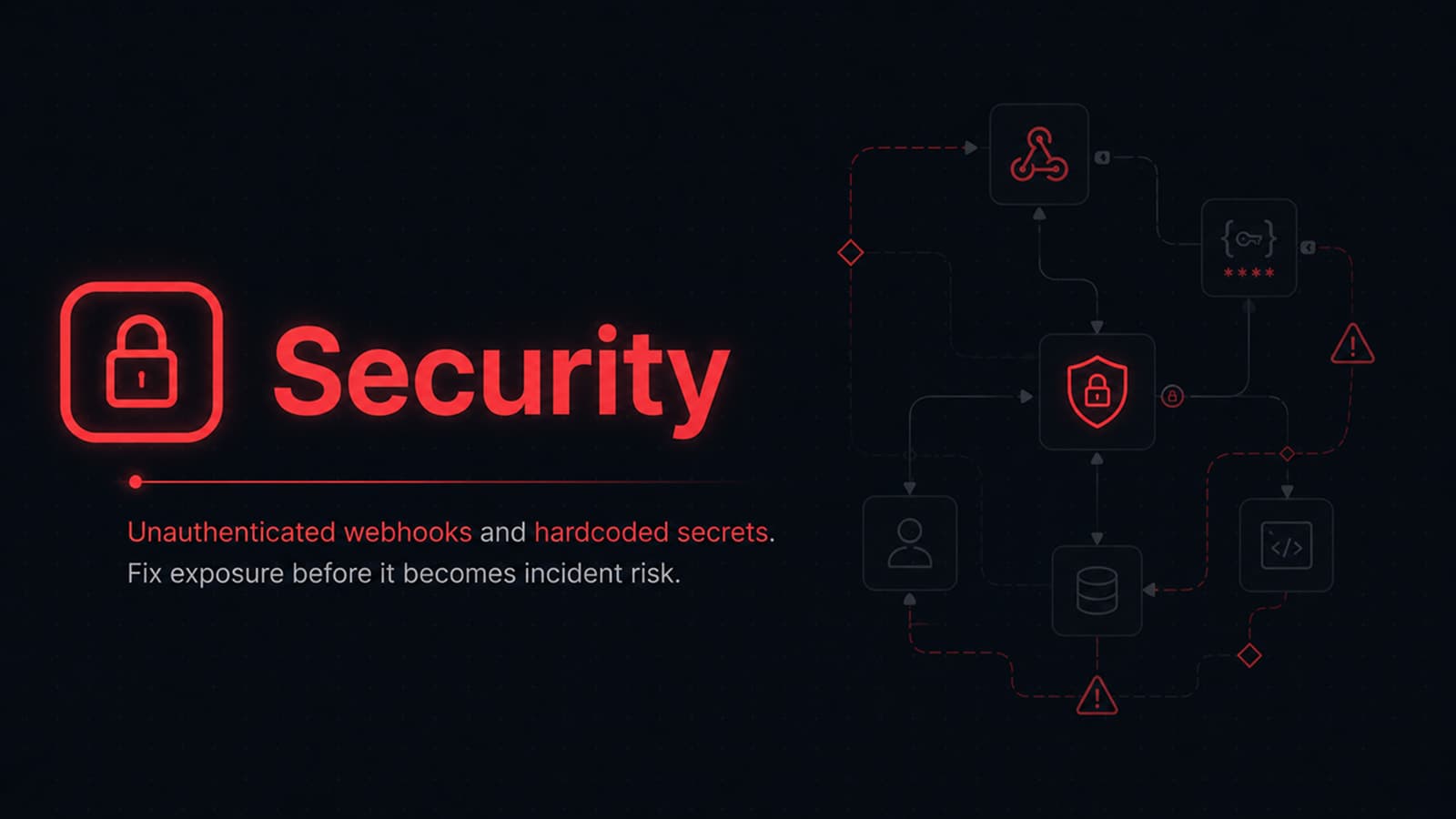
A webhook trigger looks harmless until you notice there is no authentication in front of it. An HTTP Request node looks routine until you see a bearer token pasted directly into a header. A branch looks like a simple notification path until it writes to your CRM, billing system, or database with no de-dupe check.
None of those issues require a malicious template author. Most of the time, they come from shortcuts:
- The builder used a temporary API key while testing and forgot to move it into credentials.
- The webhook path was readable because it made the demo easier to explain.
- The workflow was built for a private environment and later published as a reusable template.
- The template assumes a human will inspect and adapt every sensitive node before running it.
That last assumption is fair. The problem is that many teams import first and inspect later.
Verified authors help, but they do not replace review
Templates from verified authors are a better starting point than random exports from a forum thread. They reduce some trust risk: the author is more accountable, the template is usually documented better, and obvious junk is less likely to make it through.
Still, verification is not the same as approval for your environment.
A verified template can still be too permissive for your use case. It can still include a public webhook you should protect. It can still send too much data to a third-party API. It can still create records, send messages, update rows, or trigger payments in a way that is perfectly reasonable for the author's demo and completely wrong for your production system.
The question is not "Do I trust this author?"
The better question is: "Do I understand every path this automation can execute, and am I comfortable with what each path can read or change?"
The two checks I run before any template goes near production
When I review a public n8n template, I start with two boring checks because they catch a surprising amount of real risk.
First, I look for public entry points.
Any webhook should make you pause. Is this endpoint meant to be public? Does it require a header, shared secret, signature check, or some other gate before the workflow does real work? Is the path predictable, like /new-order or /lead-created, or is it hard to guess? If anyone with the URL can trigger the workflow, assume someone eventually will.
Then I follow the webhook downstream. A public webhook that sends a test Slack message is one level of risk. A public webhook that creates invoices, updates customer records, or pushes rows into a production database is another thing entirely.
Second, I search for hardcoded secrets.
In n8n, credentials should live in credential storage. API keys, bearer tokens, passwords, shared secrets, and private URLs should not sit inside plain node parameters. If a secret is hardcoded in a template, it travels with the workflow export. It can end up in Git, a shared drive, a support ticket, or a Slack thread without anyone noticing.
Moving secrets into credentials is not glamorous work, but it is one of the highest-value security fixes in automation.
How to review a public template before you run it
Here is a practical how to checklist I use with teams:
- Import into a sandbox n8n instance, not production.
- Disable triggers until the review is done.
- Open every credential field and replace demo values with proper n8n credentials.
- Search node parameters for
api_key,token,bearer,password,secret, andauthorization. - Review every Webhook node and add authentication if the endpoint is not intentionally public.
- Trace every path that performs a write: create, update, delete, send, charge, refund, publish, or upload.
- Add de-dupe or idempotency before write actions that could be retried.
- Check which data is sent to external APIs, especially AI tools and enrichment services.
- Add error handling before enabling the workflow.
- Run the workflow with harmless test data and inspect the execution output.
This takes less time than cleaning up one bad production run.
Use tools to verify, then use your judgment
Static analysis tools to verify workflow structure are useful because they do not get tired. They can scan exported JSON for patterns humans miss: unauthenticated webhooks, hardcoded secrets, missing error paths, risky write actions, and cost-heavy branches.
But tools are a first pass, not a permission slip.
A tool can tell you that a webhook has no obvious authentication. It cannot know whether that webhook is intentionally public because your upstream system signs payloads at the edge. A tool can flag a hardcoded-looking value. It cannot always know whether the value is a fake demo placeholder or a live key. A tool can show you the security gap; a human still has to decide the right fix.
The best review process combines both:
- Let automation scan the template quickly.
- Let a builder who understands n8n inspect the sensitive paths.
- Let the workflow owner confirm the business impact of each action.
That is how you move fast without pretending trust is a strategy.
The mindset shift
Public templates are accelerators. Treat them that way.
Do not import a template and ask, "Does it run?"
Ask:
- What can trigger it?
- What data can it read?
- What systems can it write to?
- Where are secrets stored?
- What happens if the same event arrives twice?
- What would I need to explain if this fired at 2am?
Once you can answer those questions, the template becomes yours. Until then, it is still borrowed logic running with your permissions.
That difference matters. In n8n, the dangerous part is rarely the node on the screen. It is the access behind the node.
Run a free analysis
Paste your exported n8n workflow or Make scenario JSON and get instant findings.
Open analyzer